
Cleanroom classification according to ISO 14644: a complete guide
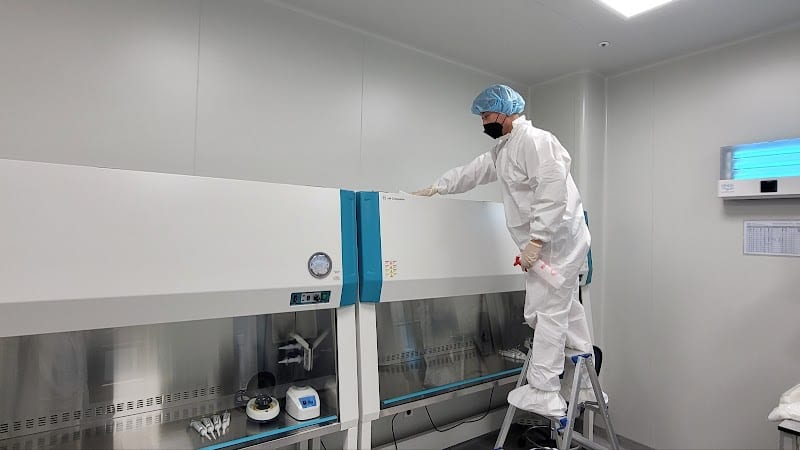
ISO 14644 is the international standard series that defines cleanroom classes and specifies how classification should be performed. The standard is the foundation for all cleanroom operations worldwide.
ISO 14644-1: Cleanroom classes
ISO 14644-1 defines nine cleanroom classes based on the maximum permitted concentration of airborne particles:
| ISO Class | Max particles ≥0.1 μm/m³ | Max particles ≥0.5 μm/m³ | Max particles ≥5.0 μm/m³ |
|---|---|---|---|
| ISO 1 | 10 | – | – |
| ISO 2 | 100 | 4 | – |
| ISO 3 | 1 000 | 35 | – |
| ISO 4 | 10 000 | 352 | – |
| ISO 5 | 100 000 | 3 520 | 29 |
| ISO 6 | 1 000 000 | 35 200 | 293 |
| ISO 7 | – | 352 000 | 2 930 |
| ISO 8 | – | 3 520 000 | 29 300 |
| ISO 9 | – | 35 200 000 | 293 000 |
How is classification performed?
Step 1: Determine the number of sampling points
The number of sampling points is based on the cleanroom area. ISO 14644-1:2015 (Table A.1) specifies these minimum numbers of sampling locations:
- Up to 2 m²: 1 sampling point
- Up to 4 m²: 2 sampling points
- Up to 6 m²: 3 sampling points
- Up to 8 m²: 4 sampling points
- Up to 10 m²: 5 sampling points
- Up to 24 m²: 6 sampling points
- Larger areas: more points per Table A.1 (e.g. up to 28 m² → 7, up to 32 m² → 8)
- And so on with increasing area
Step 2: Measure with a calibrated particle counter
The particle counter must comply with ISO 21501-4 and be calibrated. The minimum sample volume is calculated based on the classification requirements.
Step 3: Evaluate results
All measurement points must meet the classification limit. The standard specifies statistical methods for evaluation.
Occupancy states: as-built, at-rest and in-operation
Classification can be carried out in three occupancy states under ISO 14644-1:
| Occupancy state | Equipment | Personnel | Used for |
|---|---|---|---|
| As-built | No equipment, room and services only | None | Verification at handover |
| At-rest | Installed and operating | None | Classification, periodic reclassification |
| In-operation | Operating | Present, normal staffing | Monitoring during production |
The state matters as much as the class. A room that meets ISO 7 at-rest will not necessarily meet it in-operation, because people are themselves a particle source. A classification quoted without its occupancy state is incomplete.
Measurement instrument requirements
The particle counter must:
- Comply with ISO 21501-4
- Be calibrated with a traceable certificate
- Have sufficient flow rate for the applicable class
- Be qualified (IQ/OQ) in GMP environments
Read more about cleanroom monitoring and our particle counters.
Frequently asked questions
It depends on your operations. Pharmaceutical production often requires ISO 5 (Grade A/B), while electronics or food processing may manage with ISO 7–8.
ISO 14644-2 specifies that classification should be repeated at regular intervals. GMP environments often require at least annual reclassification.
If a measurement point fails the classification limit, additional measurements can be taken according to the standard's statistical method. Remedial action may be required.
Yes, we perform cleanroom classification according to ISO 14644 with calibrated particle counters and deliver complete documentation.
More articles
What is air sampling and when is it needed?
An introduction to air sampling – what it involves, which situations require it, and what to expect from the process.
How to interpret an air sampling report
A guide to understanding your air sampling report – what the results mean, how they compare against reference values, and what actions may be required.
EU GMP Annex 1: requirements for air monitoring in pharmaceutical production
EU GMP Annex 1 sets strict requirements for air monitoring in aseptic production. Read about what is required for particle counting, microbial sampling and documentation.