
Cleanroom
Complete air monitoring for cleanrooms – particle counting, microbiological sampling and validation according to ISO 14644, EU GMP Annex 1 and ISO 21501-4. We help you with continuous monitoring, classification and documentation.
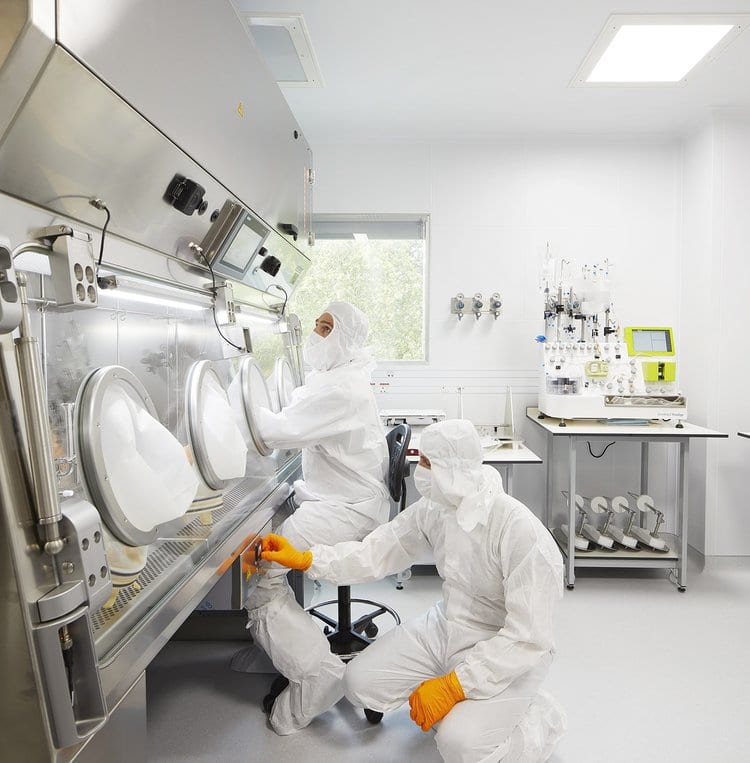
Two measurements, one goal: proving the air is clean
A cleanroom is a controlled environment where airborne particle concentration is limited to protect a product, a process or a patient. Proving that the air meets that limit comes down to two distinct measurements. Particle counting measures every airborne particle in a given size range, whether it is living or not (non-viable). Microbial air sampling measures specifically viable microorganisms, captured on an agar medium and reported as colony-forming units (CFU) after incubation. Most cleanrooms need both: particle counts establish the room's ISO class, while microbial results confirm that class isn't being undermined by biological contamination a particle counter can't distinguish from ordinary dust.
Classification under ISO 14644-1
Cleanroom classification is carried out according to ISO 14644-1, the international standard that defines nine ISO classes based on the maximum permitted concentration of airborne particles at specified sizes. Classification uses a calibrated optical particle counter – the instrument itself must meet ISO 21501-4, the separate standard governing how particle counters are calibrated, distinct from the standard that classifies the room. The number of sampling points and the minimum air volume sampled at each point scale with the room's floor area, as set out in ISO 14644-1's own tables, so a larger room needs proportionally more measurement locations to support a valid result.
Classification can be carried out in different occupancy states – as-built (complete, no equipment or personnel), at-rest (equipment installed, no personnel) or in-operation (running, with personnel present) – and the state used should match what the classification is meant to represent. A room that classifies cleanly at-rest can behave very differently in operation once people, equipment and process activity are introduced. Our guide to cleanroom classification under ISO 14644 covers the standard, the sampling-point tables and the classification process in full.
Classification is a snapshot; monitoring is continuous
Classification verifies that a cleanroom meets a specific ISO class at the moment it's measured. Environmental monitoring is a different, ongoing exercise: it demonstrates, between classifications, that the room's cleanliness is being maintained under actual day-to-day operating conditions. A monitoring programme combines particle counting and microbial sampling at defined points and intervals, with results tracked over time so a gradual drift can be caught before it shows up as a failed reclassification. The two activities complement each other – classification is the formal checkpoint, monitoring is what happens between checkpoints.
Validation, qualification and requalification
Before a cleanroom's measurement equipment can be relied on, it typically goes through IQ/OQ qualification: Installation Qualification verifies that a particle counter or air sampler has been correctly installed, and Operational Qualification verifies that it operates to specification. Requalifying both the cleanroom and its instruments is a recurring exercise rather than a one-off event, carried out on an interval set by risk assessment or triggered by a significant change – a relocation, a refurbishment, or new equipment moving into the space. Instrument calibration sits underneath all of this: a classification or monitoring result is only as trustworthy as the calibration behind the instrument that produced it.
A typical IQ/OQ engagement documents installation verification and functional testing in a qualification report, with any deviation recorded against the protocol rather than smoothed over. Calibration follows a similarly documented path: a functional check, flow calibration and particle-size verification against reference standards, adjustment where needed, and a traceable calibration certificate covering the result.
Instruments behind the numbers
Classification and monitoring run on two families of instrument: particle counters for non-viable particle counts, and active microbiological air samplers for viable organisms. Our particle counter range runs from a handheld unit for quick spot checks up to fixed, remote counters built for continuous monitoring at a single installation point, with flow rates from 2.83 to 100 L/min depending on how much air needs sampling and how many points a classification round has to cover. Our microbial air sampler is a portable active impactor that captures airborne microorganisms onto an agar plate at a controlled flow, with preset sampling plans that make it straightforward to repeat the same monitoring round across multiple points on a schedule.
Where this applies
The same ISO 14644-1 classification framework applies wherever a cleanroom is used – pharmaceutical and biotech production, hospitals and clinics, electronics manufacturing, food and quality-control labs, and research and university settings each run cleanrooms for their own reasons, but the underlying measurement discipline is shared. What differs between sectors is the regulatory overlay sitting on top of that shared framework, and the balance between particle counting and microbial sampling a given process actually needs.
Frequently asked questions
Frequently asked questions
Classification is a recurring verification that a cleanroom meets a specific ISO class at the moment it's measured. Environmental monitoring is the ongoing programme that demonstrates, between classifications, that cleanliness is maintained under actual operating conditions – combining particle counting and microbial sampling with results tracked over time.
ISO 14644-1 defines nine ISO classes (ISO 1 to ISO 9), each with a maximum permitted concentration of airborne particles at specified sizes. Classification is carried out with a calibrated particle counter, and the number of sampling points scales with the room's area.
They're occupancy states used for classification and monitoring. "At-rest" means the room is complete with equipment installed but no personnel present; "in-operation" means the room is running normally with personnel and process activity. A room can behave very differently in each state, so which one is used should match what the measurement is meant to represent.
IQ (Installation Qualification) verifies that equipment such as a particle counter or air sampler has been correctly installed; OQ (Operational Qualification) verifies that it operates to specification. Together they document that the instruments behind your classification and monitoring results can be relied on.
Related services
Cleanroom
We offer complete air monitoring for cleanrooms – from particle counting and microbiological sampling to cleanroom class...
Learn moreMicrobial Air Sampling
Microbial air sampling measures the concentration of viable microorganisms in the air – critical in cleanrooms, aseptic ...
Learn moreEnvironmental Monitoring
Environmental monitoring (EM) is the ongoing programme that demonstrates your cleanroom continues to meet requirements b...
Learn moreParticle Counting
Particle counting measures the level of airborne particles in cleanrooms and controlled environments – the foundation fo...
Learn moreCalibration
Correctly calibrated instruments are the foundation for reliable measurement results. We offer professional calibration,...
Learn moreIQ/OQ
We perform IQ/OQ qualification (Installation Qualification and Operational Qualification) for particle counters, air sam...
Learn more
Need help?
Contact us for a free assessment of your air monitoring and particle counting needs.