Products
Particle Counters
Measure airborne particles with precision – from handheld units to high-flow instruments.
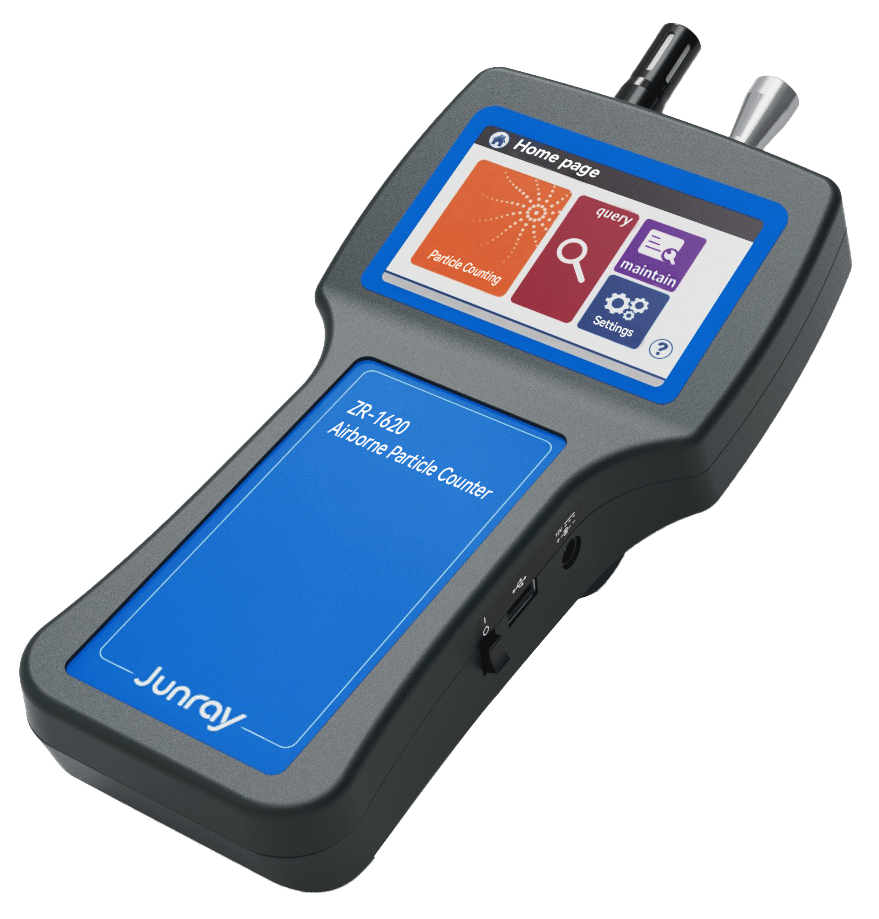
Handheld Particle Counter ZR-1620
Compact handheld 6-channel particle counter – 2.83 L/min
The ZR-1620 is a handheld 6-channel particle counter that uses the light scattering principle to measure airborne particles in sizes 0.3, 0.5, 1.0, 3.0, 5.0 and 10.0 μm. Flow is stable at 2.83 L/min via a built-in pump. The instrument is suitable for cleanroom cleanliness testing and performance testing of air filters and filter material in clean workshops, biological laboratories, pharmaceutical factories, inspection and testing institutions and bio-safety cabinet manufacturers.
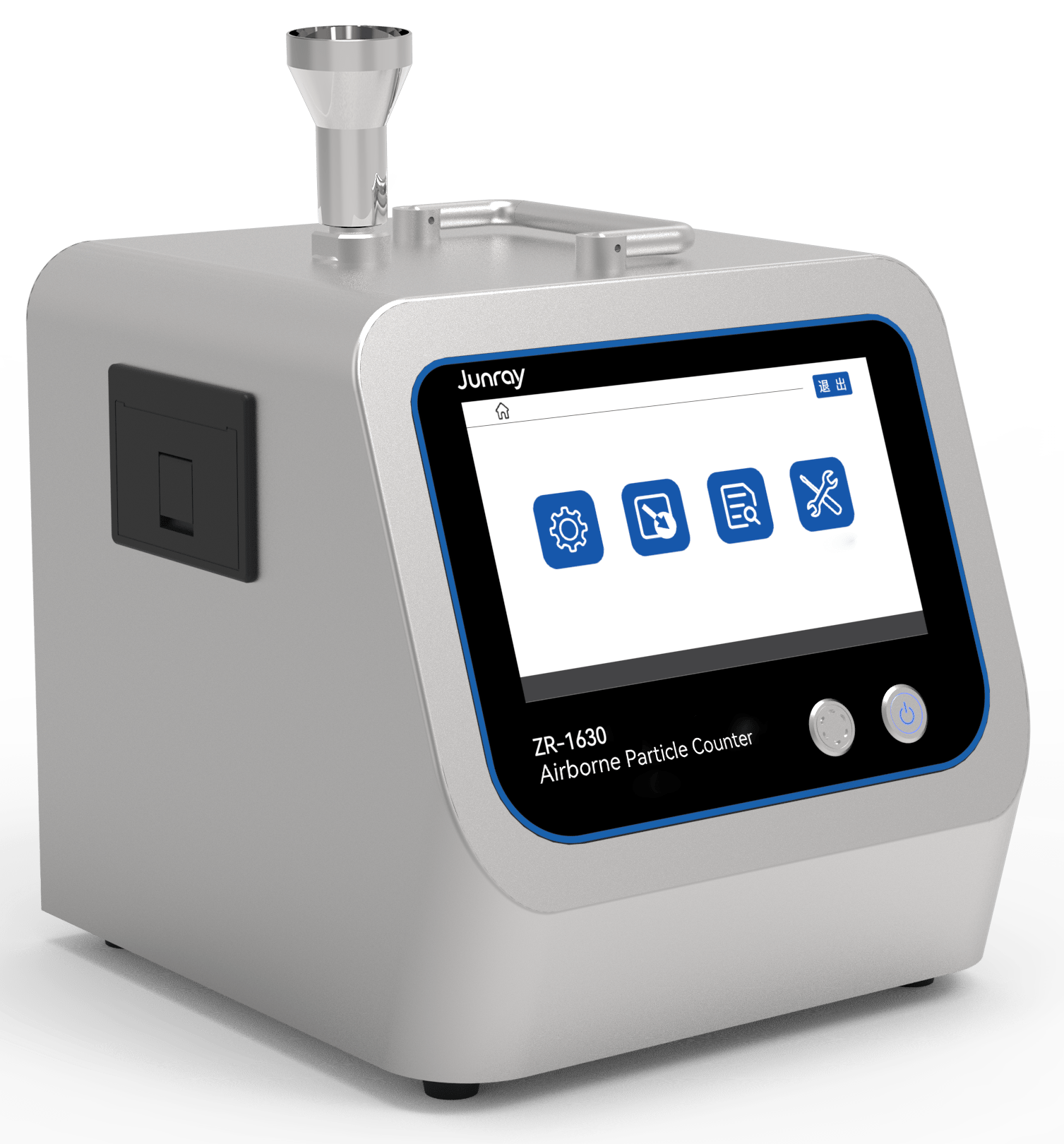
Particle Counter ZR-1630
Portable 6-channel particle counter – 28.3 L/min
The ZR-1630 is a portable 6-channel particle counter that uses the light scattering principle to measure airborne particles in sizes 0.3, 0.5, 1.0, 3.0, 5.0 and 10.0 μm. Flow is stable at 28.3 L/min via a built-in pump. The instrument is suitable for cleanroom cleanliness testing and performance testing of air filters and filter material in clean workshops, biological laboratories, pharmaceutical factories, inspection and testing institutions and bio-safety cabinet manufacturers.
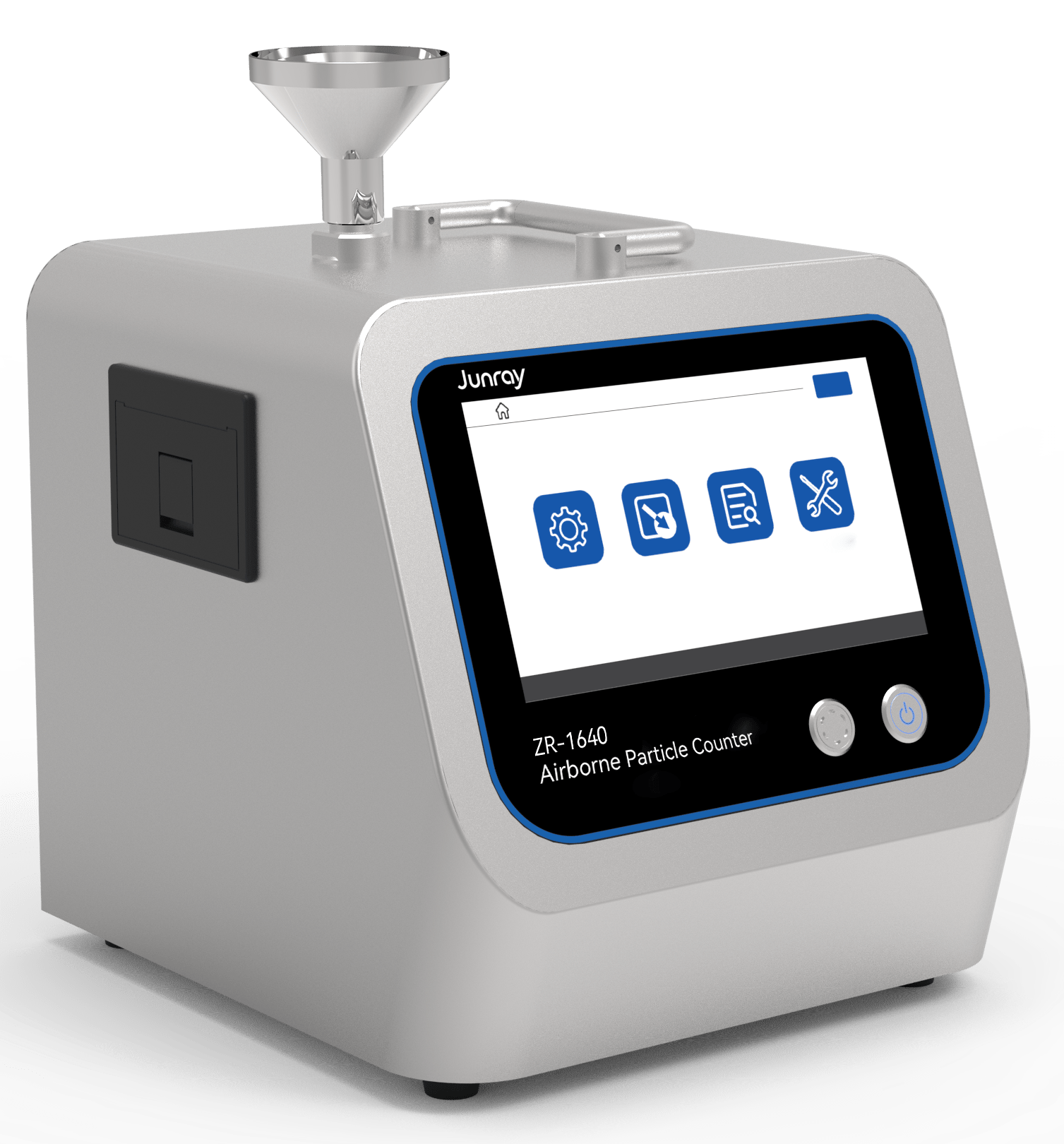
Particle Counter ZR-1640
Portable 6-channel particle counter – 100 L/min
The ZR-1640 is a portable 6-channel particle counter that uses the light scattering principle to measure airborne particles in sizes 0.3, 0.5, 1.0, 3.0, 5.0 and 10.0 μm. Flow is stable at 100 L/min via a built-in pump. The instrument is suitable for cleanroom cleanliness testing and performance testing of air filters and filter material in clean workshops, biological laboratories, pharmaceutical factories, inspection and testing institutions and bio-safety cabinet manufacturers.
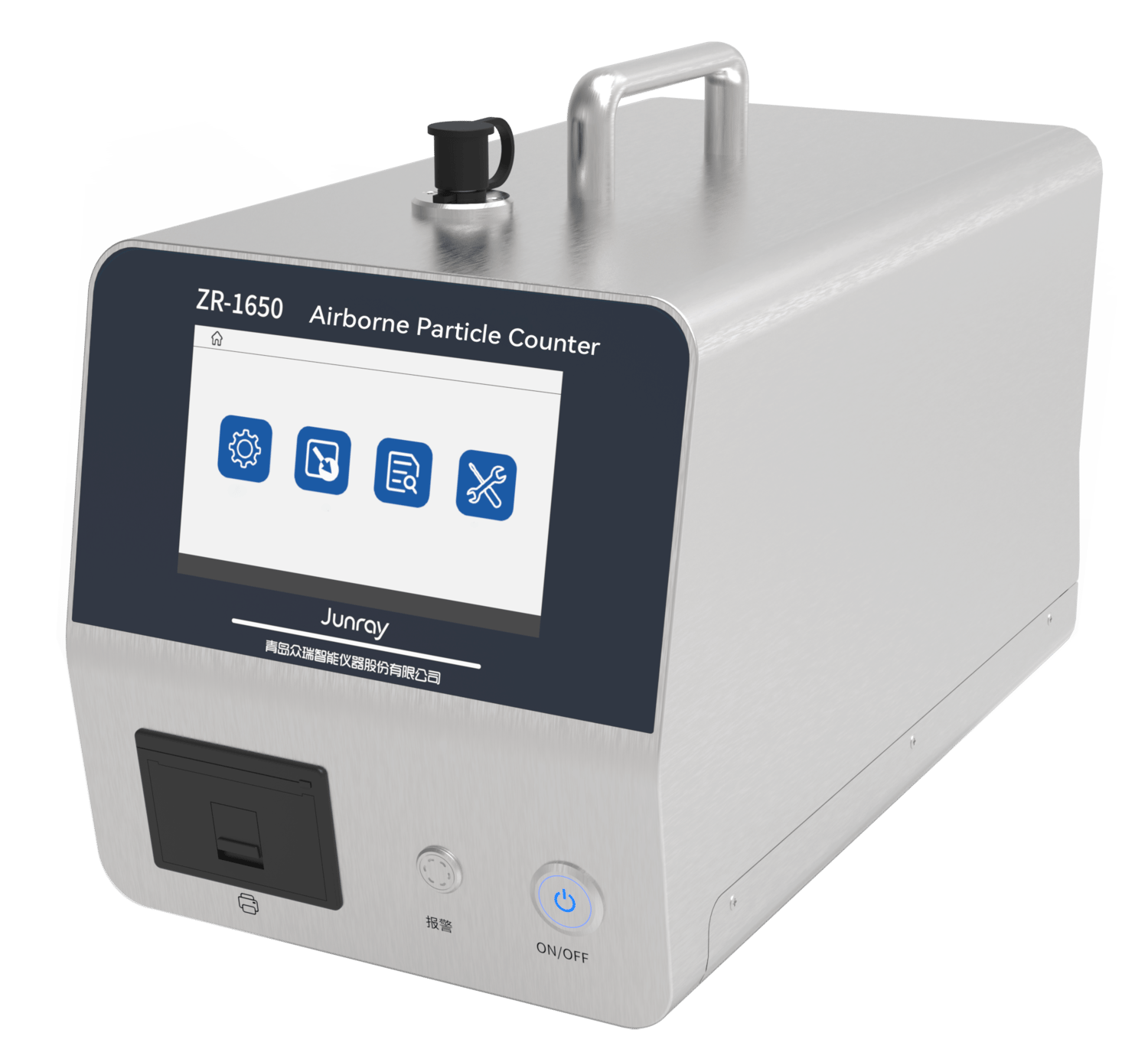
Particle Counter ZR-1650
High-precision 9-channel particle counter – 0.1 μm
The ZR-1650 is a portable 9-channel high-precision particle counter with a minimum detectable particle size of 0.1 μm and a working flow rate of 28.3 L/min (1 CFM). Using a solid-state laser based on the light scattering principle, it measures the size distribution and number concentration of airborne particles in channels 0.1, 0.15, 0.2, 0.25, 0.3, 0.5, 0.7, 1.0 and 5.0 μm. The instrument is equipped with a built-in HEPA filter for exhaust. It is suitable for semiconductor factories, electronics factories, optical laboratories, clean workshops, inspection and testing institutions and other cleanroom cleanliness testing, as well as air filter and filter material performance testing.
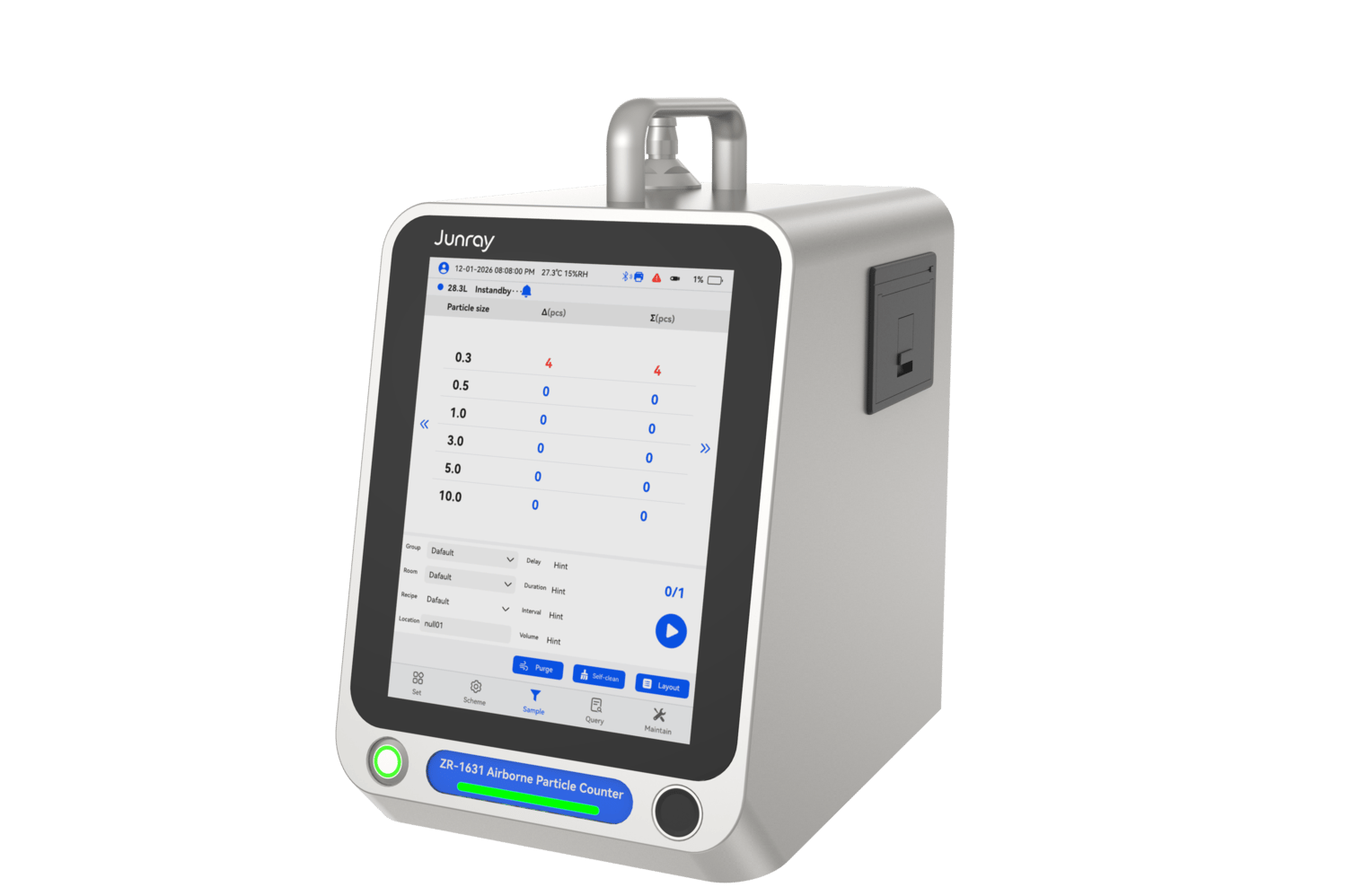
Airborne Particle Counter ZR-1631
New-generation 6-channel particle counter – 28.3 L/min
The ZR-1631 belongs to Junray's new generation of portable particle counters. The redesigned platform brings an unparalleled user experience – it supports simultaneous monitoring of six channels of airborne particles with high flow-control accuracy, and the new touchscreen interface lets you complete cleanliness testing quickly and efficiently. With 21 CFR Part 11 data integrity, fingerprint login, voice input and a built-in thermal printer, the ZR-1631 measures airborne particles in sizes 0.3, 0.5, 1.0, 3.0, 5.0 and 10.0 μm at a stable 28.3 L/min, making it suitable for pharmaceutical and biologicals production, isolators, HVAC verification and facility cleanliness monitoring.
Airborne Particle Counter ZR-1661
New-generation 6-channel particle counter – 100 L/min
The ZR-1661 is the high-flow model in Junray's new generation of portable particle counters. Sharing the same redesigned platform as the ZR-1631, it samples at a stable 100 L/min – ideal for large cleanrooms and faster classification work – while measuring airborne particles in sizes 0.3, 0.5, 1.0, 3.0, 5.0 and 10.0 μm. The 8-inch touchscreen, 21 CFR Part 11 data integrity, fingerprint login, voice input and built-in thermal printer make cleanliness testing quick, traceable and efficient for pharmaceutical and biologicals production, isolators, HVAC verification and facility monitoring.
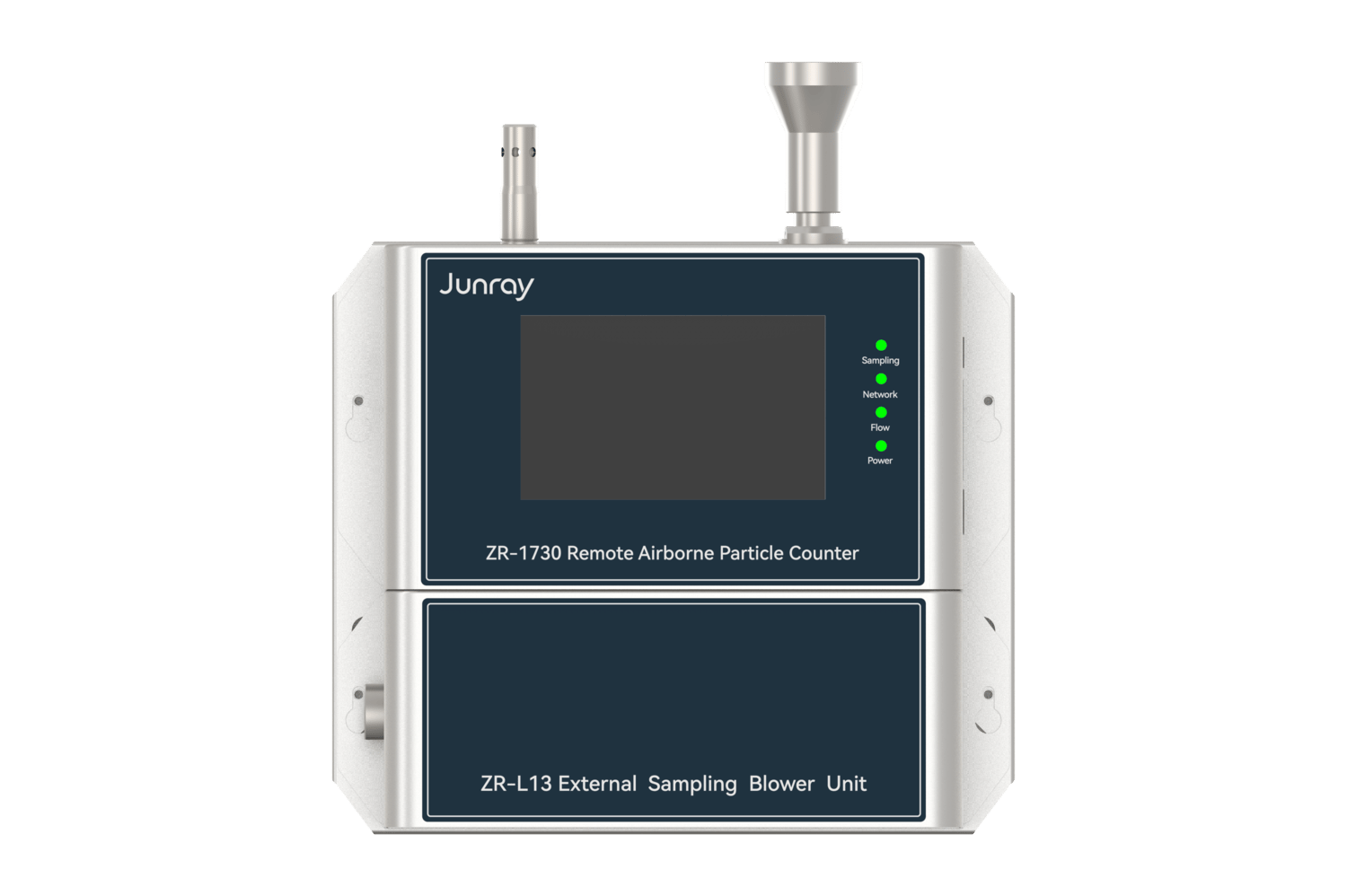
Remote Airborne Particle Counter ZR-1730
Remote particle counter with display for continuous monitoring
Based on proven light-scattering technology, the ZR-1730 provides continuous, real-time airborne particle monitoring for pharmaceutical plants, biotech laboratories, semiconductor fabs and hospital cleanrooms. This model is the display-equipped version (an external touch screen is available as an option) and works with the ZR-L13 external sampling blower unit. The built-in HEPA filter ensures exhaust air is particle-free, while the rugged 316L enclosure withstands aggressive VHP and disinfectants. Designed for long-term unattended operation, it delivers actionable data, instant alarms and full regulatory compliance.
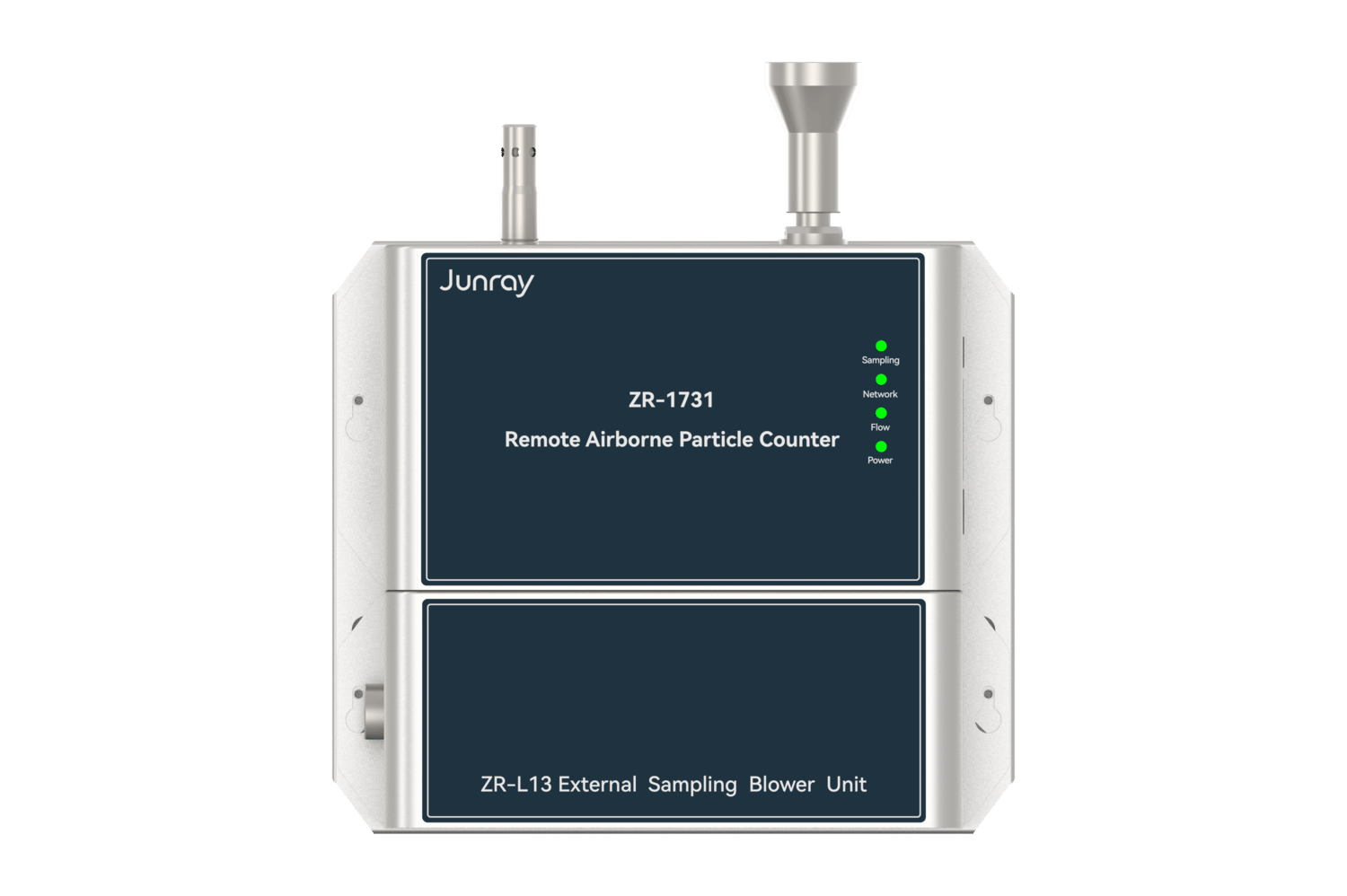
Remote Airborne Particle Counter ZR-1731
Display-free remote particle counter for networked monitoring
The ZR-1731 is the display-free variant of Junray's remote airborne particle counter, designed for fully networked, centralised cleanroom monitoring where data is read at a central station. Status is shown via LED indicators while measurements stream to your monitoring system. Like the ZR-1730 it uses proven light-scattering technology, works with the ZR-L13 external sampling blower unit, and provides continuous real-time monitoring for pharmaceutical plants, biotech laboratories, semiconductor fabs and hospital cleanrooms. The built-in HEPA filter keeps exhaust particle-free and the rugged 316L enclosure withstands aggressive VHP and disinfectants for long-term unattended operation.
Compare specifications
| Model | Flow rate | Channels | Light source | Concentration limit | Display | Battery | Communication | Dimensions | Weight | Power | Zero count | Data integrity | Exhaust filtration | Enclosure material | Maximum concentration | Sampling modes | Data storage | Preset rooms / points | Sampling volume | Interfaces | Power supply | Noise |
|---|---|---|---|---|---|---|---|---|---|---|---|---|---|---|---|---|---|---|---|---|---|---|
| ZR-1620 | 2.83 L/min (±2%) | 0.3, 0.5, 1.0, 3.0, 5.0, 10.0 μm | Laser diode | 3 500 000/ft³ | 3.5-inch colour touchscreen | Lithium-ion, ≥3 h continuous measurement | USB, Bluetooth | 240 × 120 × 110 mm | Approx. 1 kg | ≤7 W | – | – | – | – | – | – | – | – | – | – | – | – |
| ZR-1630 | 28.3 L/min (±2%) | 0.3, 0.5, 1.0, 3.0, 5.0, 10.0 μm | Laser diode | 37 000 000/m³ | 7-inch colour touchscreen | Replaceable lithium, ≥9 h continuous measurement | USB, WiFi, Bluetooth, RS485, BNC | 240 × 265 × 265 mm | Approx. 8 kg | ≤120 W | – | – | – | – | – | – | – | – | – | – | – | – |
| ZR-1640 | 100 L/min (±2%) | 0.3, 0.5, 1.0, 3.0, 5.0, 10.0 μm | Laser diode | 17 000 000/m³ | 7-inch colour touchscreen | Replaceable lithium, ≥4 h continuous measurement | USB, WiFi, Bluetooth, RS485, BNC | 240 × 265 × 265 mm | Approx. 8.2 kg | ≤180 W | – | – | – | – | – | – | – | – | – | – | – | – |
| ZR-1650 | 28.3 L/min (±2%) | 0.1, 0.15, 0.2, 0.25, 0.3, 0.5, 0.7, 1.0, 5.0 μm | Solid-state laser | 17 000 000 pcs/m³ | 7-inch colour touchscreen | Replaceable lithium, ≥4 h continuous measurement | USB, WiFi, Bluetooth, RS485 (Modbus-RTU), BNC | 445 × 240 × 315 mm | Approx. 11.6 kg | ≤200 W | – | – | – | – | – | – | – | – | – | – | – | – |
| ZR-1631 | 28.3 L/min (±2%) | 0.3, 0.5, 1.0, 3.0, 5.0, 10.0 μm | Laser diode | 37 000 000/m³ (10% coincidence loss) | 8-inch colour touchscreen | ≈8 h (two hot-swappable batteries) | WiFi, Bluetooth, USB, RS485, RS232, RJ45, analog, 4–20 mA | 252 × 172 × 287 mm | Approx. 5.6 kg (without battery) | ≤120 W | <1 count / 5 min | Three-level user management, audit trail, 21 CFR Part 11 | Built-in HEPA filter (>99.97% @ 0.3 μm) | 316L stainless steel | – | – | – | – | – | – | – | – |
| ZR-1661 | 100 L/min (±2%) | 0.3, 0.5, 1.0, 3.0, 5.0, 10.0 μm | Laser diode | 17 000 000/m³ (10% coincidence loss) | 8-inch colour touchscreen | ≈8 h (two hot-swappable batteries) | WiFi, Bluetooth, USB, RS485, RS232, RJ45, analog, 4–20 mA | 252 × 172 × 287 mm | Approx. 5.6 kg (without battery) | ≤180 W | <1 count / 5 min | Three-level user management, audit trail, 21 CFR Part 11 | Built-in HEPA filter (>99.97% @ 0.3 μm) | 316L stainless steel | – | – | – | – | – | – | – | – |
| ZR-1730 | 28.3 L/min (±2.5%) | 0.3, 0.5, 1.0, 3.0, 5.0, 10.0 μm | Laser diode | – | – | – | Wi-Fi, Bluetooth, RS485, RS232 | 205 × 105 × 125 mm (excluding ports) | Approx. 2 kg | – | <1 count / 5 min | – | Built-in HEPA filter | – | 37 000 000 particles/m³ (10% coincidence loss) | Manual, automatic; concentration mode, count mode | 8 GB (≈100 000 groups) | 20 000 rooms, 200 000 points | 2.82–28 300 L | USB, RS485, RJ45, analog, pulse, temperature/humidity | DC 24V | ≤60 dB(A) |
| ZR-1731 | 28.3 L/min (±2.5%) | 0.3, 0.5, 1.0, 3.0, 5.0, 10.0 μm | Laser diode | – | None – LED status indicators | – | Wi-Fi, Bluetooth, RS485, RS232 | 205 × 105 × 125 mm (excluding ports) | Approx. 2 kg | – | – | – | Built-in HEPA filter | – | 37 000 000 particles/m³ (10% coincidence loss) | Manual, automatic; concentration mode, count mode | 8 GB (≈100 000 groups) | 20 000 rooms, 200 000 points | 2.82–28 300 L | USB, RS485, RJ45, analog, pulse, temperature/humidity | DC 24V | ≤60 dB(A) |
Handheld, portable or fixed: three form factors, one measurement principle
All eight instruments in this range measure airborne particles by light scattering: air is drawn through the instrument at a controlled flow, each particle that crosses the beam scatters light in proportion to its size, and the scattered light is converted into a size channel. Seven of the eight use a laser diode light source; the ZR-1650 uses a solid-state laser instead.
The ZR-1620 is the only genuinely handheld model – about 1 kg, built for quick spot checks in tight spaces rather than a scheduled classification round. The ZR-1630, ZR-1640, ZR-1650, ZR-1631 and ZR-1661 are portable: heavier (roughly 5.6–11.6 kg), with a built-in printer and preset rooms or recipes, designed to be carried between several sampling points during a classification round.
The ZR-1730 and ZR-1731 are fixed, remote instruments instead: neither lists a battery, both are specified for DC 24 V power, and both pair with the ZR-L13 external sampling blower unit for continuous, real-time monitoring rather than spot sampling. The difference between the two is the display – the ZR-1730 has an on-board display (with an external touchscreen available as an option), while the ZR-1731 is display-free and relies on LED status indicators, a configuration built for installations with many monitoring points where a screen on every unit would be redundant.
What the flow rate means in practice
Flow rate is how much air the instrument draws per minute, and it spans 2.83 to 100 L/min across the range. A higher flow samples a given air volume faster, which is why the 100 L/min models (ZR-1640, ZR-1661) are positioned for large cleanrooms and production environments with many sampling points – the same sample volume is simply reached sooner.
There is a trade-off worth reading in the comparison table: among the 28.3 L/min and 100 L/min models specified in particles/m³, the concentration limit – the upper particle count above which coincidence loss (two particles counted as one) starts to distort the result – is lower at 100 L/min (17,000,000/m³ for the ZR-1640 and ZR-1661) than at 28.3 L/min (37,000,000/m³ for the ZR-1630, ZR-1631, ZR-1730 and ZR-1731). The ZR-1650 breaks that pattern at 17,000,000/m³ despite its 28.3 L/min flow, which lines up with its finer nine-channel resolution rather than with flow rate itself. The ZR-1620's concentration limit is specified per cubic foot rather than per cubic metre, so it isn't directly comparable to the other seven on this figure.
Six channels or nine: resolution at the low end
Seven of the eight instruments measure six channels simultaneously – 0.3, 0.5, 1.0, 3.0, 5.0 and 10.0 μm. The ZR-1650 is the exception: nine channels down to 0.1 μm, though its largest channel tops out at 5.0 μm rather than 10.0 μm. That finer low-end resolution is why the ZR-1650 is positioned for semiconductor fabrication, electronics manufacturing and optical laboratories, where sub-micron particles are the ones that matter.
Reading the comparison table
The table above lists every spec label that appears on at least one of the eight product sheets; a blank cell means that particular figure isn't stated for that model, not that the instrument lacks the feature. Flow rate, channel count and concentration limit are the three columns that separate the instruments most, and are the natural starting point for a side-by-side comparison.
Display size, battery life and communication interfaces (USB, WiFi, Bluetooth, RS485) speak more to day-to-day handling: a handheld unit with a short runtime suits quick spot checks, while the portable models with longer battery life and preset recipes are built for longer classification rounds across several rooms.
ISO 21501-4: the calibration standard, distinct from room classification
All eight instruments list ISO 21501-4:2018 among their standards – this is the calibration standard for light-scattering airborne particle counters, governing how the instrument itself is tested and calibrated, not how a cleanroom is classified. All eight also list ISO 14644 (in some form) among their standards, which is the standard that classifies the room from the measured particle counts.
The two standards answer different questions: ISO 21501-4 is what makes the instrument's reading trustworthy; ISO 14644 is what that reading means for the room's class. Which specific instrument – flow rate, channel count, form factor – is the right fit for a given facility depends on room size, layout and the classification and monitoring programme being run, not on any single spec. Contact us for advice on the right instrument for your cleanroom.
Data integrity and cleanroom-hardened construction
The ZR-1631 and ZR-1661 are built for 21 CFR Part 11 data integrity, with three-level user management and an audit trail also present on several other models – relevant for pharmaceutical manufacturing and other FDA-regulated environments. Five of the eight (ZR-1650, ZR-1631, ZR-1661, ZR-1730, ZR-1731) use a 316L stainless steel enclosure, which tolerates alcohol, VHP and common disinfectants – a requirement in aseptic cleanrooms. Every model in the range filters its own exhaust so the instrument doesn't become a contamination source in the room it's measuring; the ZR-1631 and ZR-1661 specify that exhaust filtration at above 99.97% at 0.3 μm.
Frequently asked questions about particle counters
A handheld model like the ZR-1620 is built for quick spot checks and being carried between locations. Fixed, remote models like the ZR-1730 and ZR-1731 have no battery, are powered via DC 24V, and are built for continuous, real-time monitoring at one installation point rather than being moved around.
Flow rate is how much air the instrument draws per minute. The range spans 2.83 L/min (ZR-1620) to 100 L/min (ZR-1640 and ZR-1661) – a higher flow samples a given air volume faster, which is more time-efficient across many sampling points in large cleanrooms.
Seven of the eight models measure six channels simultaneously (0.3–10.0 μm). The ZR-1650 measures nine channels with finer resolution down to 0.1 μm, which is relevant for semiconductor and electronics manufacturing.
Yes. All eight models list ISO 21501-4:2018 among their standards – the calibration standard for light-scattering particle counters.

Need help choosing the right equipment?
Contact us for advice on which equipment suits your operations.