
Products
Airflow Visualisation
Visualise airflow patterns in cleanrooms with controlled fog generation.
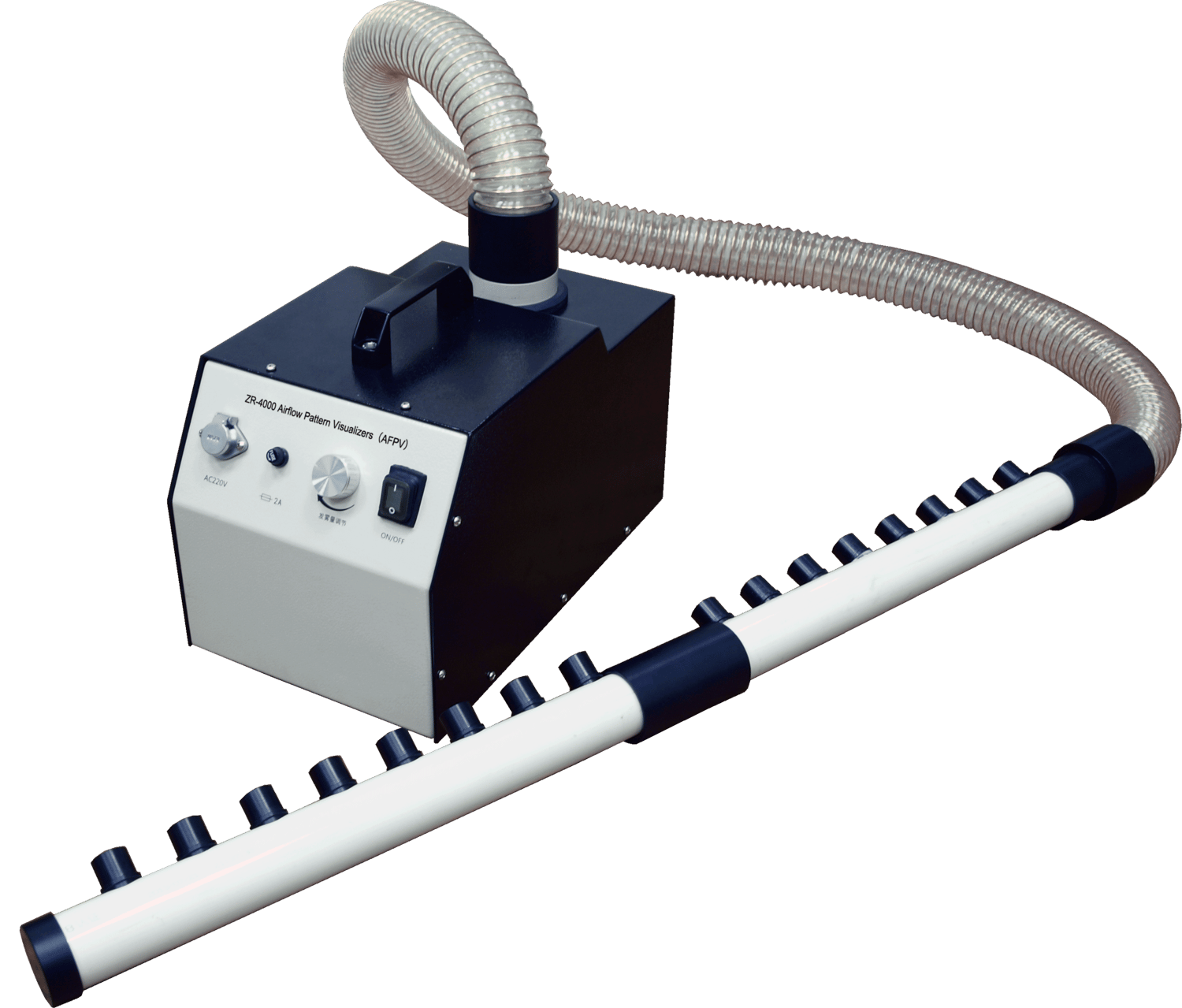
Airflow Pattern Visualiser ZR-4000
Fog generator for visualising airflow patterns in cleanrooms
The ZR-4000 Airflow Pattern Visualizer (AFPV) is excellent equipment for generating fog compliantly within sterile cleanrooms and is incredibly easy and safe to use. The AFPV generates 1–10 μm water mist to visualise airflow and observe its movement, helping to judge whether vortices and turbulence occur.
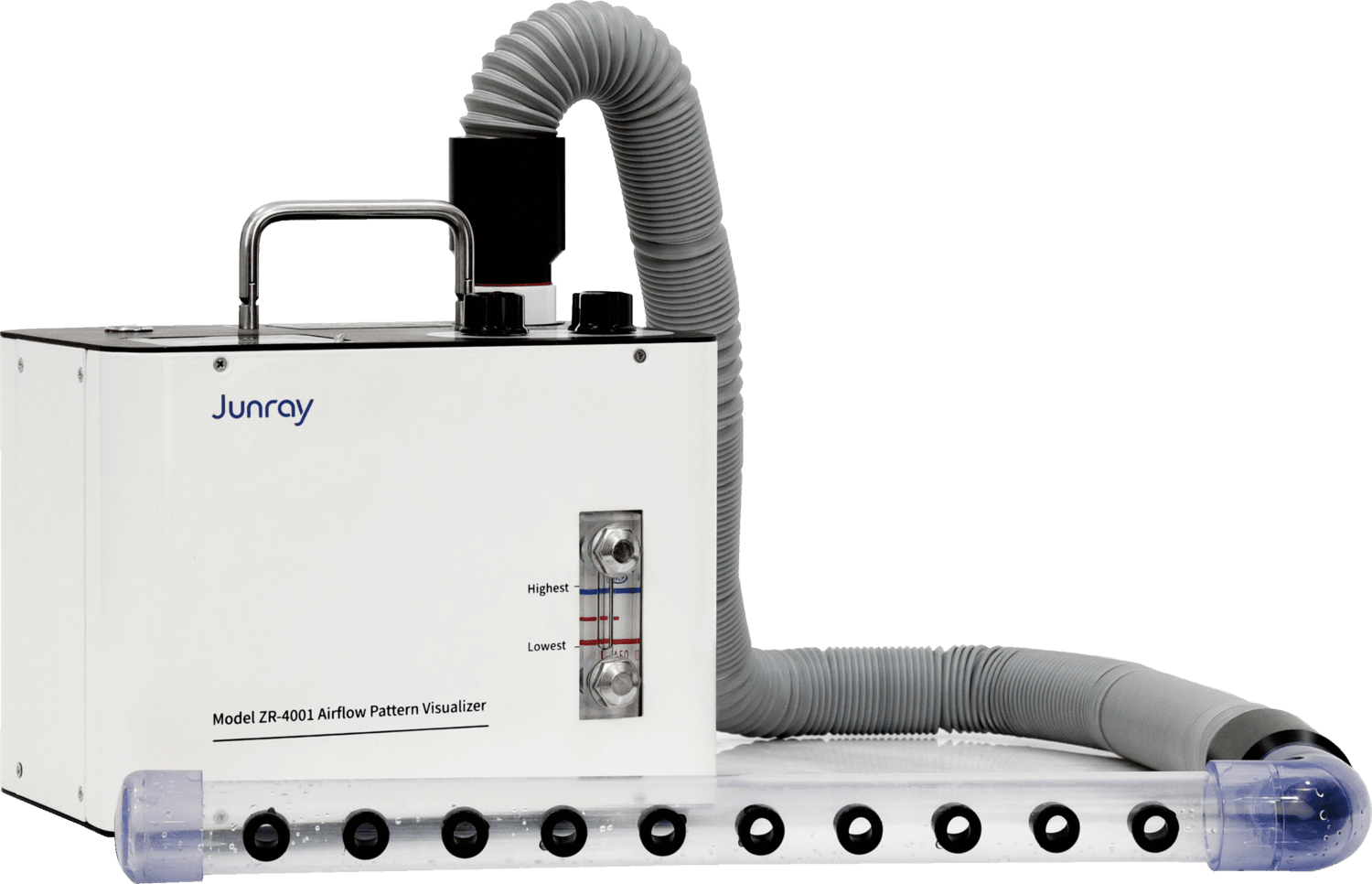
Airflow Pattern Visualiser ZR-4001
Compact portable fog generator with battery
The ZR-4001 Airflow Pattern Visualizer uses ultrasonic atomisation to produce visible DI water fog with particle size of 1–10 μm. It helps observe airflow patterns including flow direction and whether the airflow has vortices or dead points. The instrument is used for cleanroom airflow visualisation in pharmaceutical factories and cleanroom validation organisations, and for biosafety cabinet quality testing by BSC manufacturers and validation organisations.
Compare specifications
| Model | Droplet size | Fog production | Fog volume | Fog height | Operating temperature | Power supply | Noise | Dimensions | Weight | Power | Water consumption | Water capacity | Battery |
|---|---|---|---|---|---|---|---|---|---|---|---|---|---|
| ZR-4000 | 1–10 μm | ≥5500 mL/h | Approx. 0.95 m³/min | 100–150 cm | 0–50 °C | AC 220±22 V, 50±1 Hz | <65 dB(A) | 240 × 410 × 300 mm | Approx. 8.5 kg | ≤210 W | – | – | – |
| ZR-4001 | 1–10 μm | ≤0.216 m³/min | – | Approx. 1.2 m | 0–50 °C | – | <60 dB(A) | 172 × 262 × 227 mm | 3.2 kg (without water) | ≤120 W | ≤10 mL/min | ≥60 min (standard level) | ≥60 min at full charge |
Why airflow has to be seen, not only measured
A particle count tells you how many particles are in the air at a sampling point. It says nothing about how the air arrived there — whether the flow is unidirectional or turbulent, whether vortices form behind equipment, or whether contaminated air is being drawn back into a protected zone. Two rooms can return comparable counts at rest and behave completely differently in operation.
Airflow visualisation makes the movement visible. Introducing a fine water fog into the airstream lets you observe flow direction, see where turbulence develops, and document that protected air actually sweeps the surface it is meant to protect.
How fog generation works
Both instruments produce a water fog with a droplet size of 1–10 μm. That size range is the whole point: droplets in it follow the airstream rather than falling out of it, which is what makes the fog a trustworthy marker for how the air is actually moving.
The ZR-4001 uses ultrasonic atomisation of deionised water, so what enters the environment is water.
Choosing between ZR-4000 and ZR-4001
The ZR-4000 is the higher-output unit: fog production ≥ 5,500 mL/h, roughly 0.95 m³/min of fog volume, and a fog height of 100–150 cm. It runs from mains power and weighs approximately 8.5 kg, which suits larger areas and stationary work.
The ZR-4001 is compact and battery-powered, giving at least 60 minutes of runtime, roughly 1.2 m fog height and ≤ 0.216 m³/min. It suits work across multiple locations, or anywhere a mains-connected unit is impractical — in and around biosafety cabinets, for example.
Both operate between 0 and 50 °C, at under 65 and 60 dB(A) respectively.
When visualisation is used
The listed applications cover cleanroom validation, pharmaceutical production and work with biosafety cabinets. In practice that means commissioning a new room, troubleshooting counts that deviate without an obvious cause, and documenting airflow for audit.
The ZR-4000's standards include GMP, ISO 14644, IEST-RP-006.3 (2012), USP 797 and NSF 49; the ZR-4001 lists ISO 14644-3, NSF/ANSI 49-2024, EN 12469-2000 and JJF 1815-2020.
Visualisation complements particle counting rather than replacing it.
Frequently asked questions about airflow visualisation
Particle counting gives a number at a sampling point. Visualisation shows how the air moves — flow direction, where turbulence and vortices form, and whether protected air sweeps the intended surface. A room can return acceptable counts and still have a flow pattern that fails to protect the process.
The ZR-4000 is the larger mains-powered unit, producing ≥ 5,500 mL/h with a fog height of 100–150 cm, suited to stationary work and larger areas. The ZR-4001 is compact and battery-powered with at least 60 minutes of runtime and roughly 1.2 m fog height, for portable work. Both give a 1–10 μm droplet size.
Droplets in that range are light enough to follow the airstream rather than settling out of it. That is what makes the fog a valid indicator of how the air is actually moving, rather than of how the droplets fall.
Water. The ZR-4001 ultrasonically atomises deionised water, and the ZR-4000 generates a water mist.

Need help choosing the right equipment?
Contact us for advice on which equipment suits your operations.