
Electronics (Cleanroom)
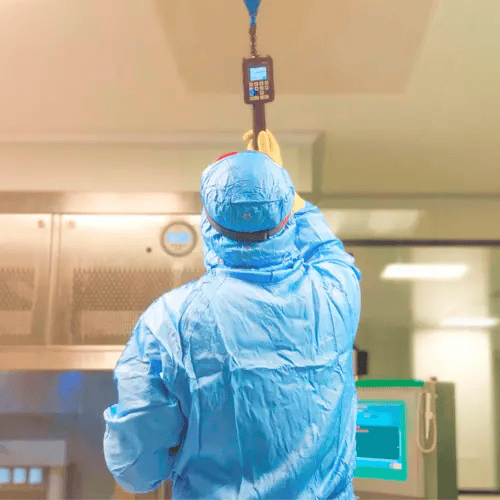
Semiconductor and electronics production demands extremely particle-free environments. We offer particle counting and cleanroom monitoring for the manufacture of electronics, chips and components.
Why particle contamination matters in electronics manufacturing
Airborne particles that settle on a semiconductor wafer, a bare PCB or an exposed component during assembly can affect the finished product without any biological contamination being involved – a purely particulate concern, which is why electronics cleanrooms lean almost entirely on particle counting rather than microbial sampling. Controlling that airborne particle level is what makes an electronics cleanroom a cleanroom in the ISO 14644-1 sense, exactly as in any other sector. Because these processes typically run continuously across a shift, a rise in airborne particle levels partway through can point to a process change, a door left open, or a piece of equipment starting to shed particles – exactly the kind of signal particle counting is built to catch.
Finer resolution for sub-micron work
Most of our particle counters measure six channels from 0.3 to 10.0 μm, which suits general cleanroom classification. The ZR-1650 is the exception in our range: a nine-channel instrument with resolution down to 0.1 μm, positioned specifically for semiconductor fabrication, electronics manufacturing and optical laboratories, where sub-micron particles are the ones that matter most. Which resolution is appropriate depends on the process being protected, not on the sector alone.
Classification and calibration underneath the process
Classification follows the same ISO 14644-1 framework used across every sector on this site – the room is measured with a calibrated particle counter and assigned an ISO class based on measured particle concentration. The counter itself is calibrated separately under ISO 21501-4, and in regulated or high-value production lines the instruments are typically qualified through IQ/OQ before going into service, so both the room and the measurement chain behind it are documented.
A typical IQ/OQ engagement documents installation verification and functional testing in a qualification report, giving the same audit trail expected in a regulated facility even where the immediate driver is production yield rather than a compliance mandate. See our guide to particle counter calibration for what a calibration actually verifies before an instrument goes into service.
Handheld, portable or fixed, depending on the work
A handheld particle counter suits a quick spot check at a single workstation or during troubleshooting. A portable counter with preset rooms or recipes suits a scheduled classification round across a larger cleanroom with several sampling points. A fixed, remote counter – powered continuously rather than by battery – suits an installation that needs ongoing monitoring at one point without someone carrying an instrument to it each time. Which form factor fits depends on how the space is used, not on the fact that it's an electronics cleanroom specifically.
Instruments that don't add to the problem they're measuring
Every particle counter in our range filters its own exhaust air, so the instrument doesn't become a contamination source in the space it's measuring – a detail that matters as much in an electronics cleanroom as anywhere else, since the whole point of the measurement is to characterise particles that are already there, not add more.
Component handling and assembly environments
Beyond the classified cleanroom itself, particle counting is also used around component handling and assembly stations – anywhere sensitive parts are exposed to open air during manufacture. A spot measurement with a portable counter can identify whether a particular workstation or process step is a disproportionate source of airborne particles, ahead of a full requalification of the space.
Documentation for internal and customer quality reviews
A classification or monitoring report gives you dated, traceable data to show a customer's quality team, support an internal investigation into a defect trend, or establish a baseline before and after a process or layout change. The report format is the same one we use for any regulated cleanroom, even where nothing in your process is itself subject to external regulation.
Frequently asked questions
Frequently asked questions
Airborne particles that settle on a wafer, PCB or exposed component can affect the finished product – a purely particulate concern rather than a biological one, which is why electronics cleanrooms lean on particle counting rather than microbial sampling.
Yes. The ZR-1650 measures nine channels down to 0.1 μm and is positioned for semiconductor fabrication, electronics manufacturing and optical laboratories, alongside our standard six-channel instruments covering 0.3–10.0 μm.
Usually not the primary concern – electronics contamination is typically particulate rather than biological, so electronics cleanrooms are classified and monitored mainly through particle counting.
Yes, we provide traceable calibration under ISO 21501-4 and can carry out IQ/OQ qualification for instruments going into regulated or high-value production lines.
Related services
Cleanroom
We offer complete air monitoring for cleanrooms – from particle counting and microbiological sampling to cleanroom class...
Learn moreParticle Counting
Particle counting measures the level of airborne particles in cleanrooms and controlled environments – the foundation fo...
Learn moreCalibration
Correctly calibrated instruments are the foundation for reliable measurement results. We offer professional calibration,...
Learn moreIQ/OQ
We perform IQ/OQ qualification (Installation Qualification and Operational Qualification) for particle counters, air sam...
Learn more
Need help?
Contact us for a free assessment of your air monitoring and particle counting needs.