Pharmaceuticals & Biotech
Microbiological air monitoring in cleanrooms, aseptic production and sterility testing. We deliver sampling and particle counting according to EU GMP Annex 1, ISO 14644 and 21 CFR Part 11.
Environmental monitoring under EU GMP Annex 1
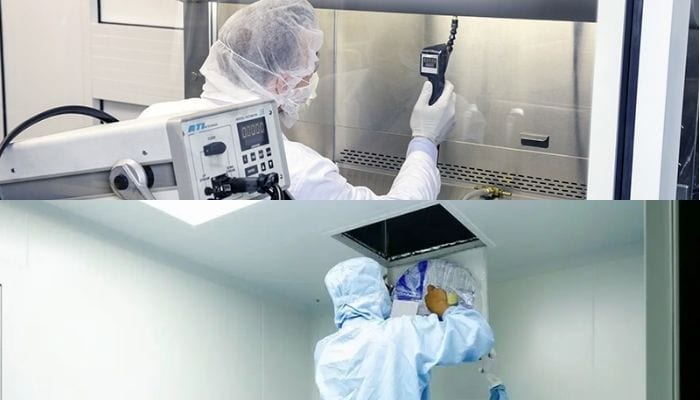
Aseptic pharmaceutical and biotech production is governed by EU GMP Annex 1, which sets out the expectation that manufacturers run a structured environmental monitoring programme across their aseptic and supporting areas. The programme is meant to sit inside a documented, risk-based contamination control strategy rather than stand as a one-off test – monitoring runs alongside production, not only at fixed checkpoints. The specific limits, grades and sampling frequencies that apply to a given facility are set out in Annex 1 itself and depend on the operation, so we work from your facility's own risk assessment and documentation rather than asserting a generic figure here.
Particle counting and microbial sampling, side by side
Two measurements make up an EM programme. Particle counting measures non-viable airborne particles and is the basis for cleanroom classification under ISO 14644-1. Microbial air sampling measures viable microorganisms – captured on an agar medium and reported as CFU after incubation – and is what verifies that a room's biological cleanliness matches its particle-based classification. Neither measurement substitutes for the other: a room can return a clean particle count while still carrying a microbial contamination risk that only viable sampling would catch, which is why aseptic production monitors both in parallel.
Trending, and alert/action limits
An EM programme is built around defined sampling points, an established frequency, and alert and action limits with a clear escalation path when a result crosses one of them. Results are tracked over time rather than assessed in isolation, so a gradual drift across several sampling rounds is visible before it turns into an isolated failing result. Which limits and escalation steps apply to your facility come from your own risk assessment and Annex 1 documentation, not from a generic figure.
Sterility assurance and sterility testing support
Air monitoring feeds directly into sterility assurance for sterile pharmaceuticals – verification carried out before and during production, alongside the microbial and particle data collected as part of the wider EM programme. Where a facility also runs sterility testing, the same disciplines of calibrated sampling and documented method apply, so results stand up under audit and regulatory inspection.
Instruments used for aseptic monitoring
Microbial sampling in aseptic areas is typically done with a portable active air sampler: air is drawn through the instrument at a controlled flow and captured on an agar plate for incubation, with preset sampling points and plans that support a repeatable, scheduled monitoring round rather than a one-off test. On the particle-counting side, some of our particle counters are built with 316L stainless steel enclosures that tolerate alcohol, VHP and other disinfectants used in aseptic areas, and with filtered exhaust so the instrument itself doesn't add particles to the room it's measuring.
Instrument qualification, calibration and data integrity
Instruments used in Annex 1 monitoring are typically brought through IQ/OQ qualification before they go into service, and recalibrated on a recurring schedule so results stay traceable over the life of the programme. Some particle counters in our range are built specifically for regulated pharmaceutical use, with three-level user management and an audit trail for 21 CFR Part 11 data integrity, so electronic records meet the same integrity expectations as the rest of your quality system.
Classification versus the ongoing programme
As in any cleanroom, classification under ISO 14644-1 and ongoing environmental monitoring are two different things: classification is the periodic checkpoint that a room meets its assigned class, and monitoring is the continuous evidence that cleanliness holds up between checkpoints. In a GMP setting the two are tightly linked – the monitoring programme is what an inspector will expect to see trending over time, not just a single passing classification result. Read more in our guide to EU GMP Annex 1 air monitoring requirements.
Frequently asked questions
Frequently asked questions
Annex 1 expects a structured, risk-based monitoring programme across aseptic and supporting areas, combining particle counting and microbial air sampling as part of your contamination control strategy. The specific limits and frequencies that apply depend on your facility and operation.
Particle counting measures all airborne particles and underpins ISO 14644-1 classification. Microbial sampling specifically measures viable microorganisms. A room can pass on particle count alone while still carrying a microbial risk, so aseptic production monitors both.
Some models in our range are built for regulated pharmaceutical use with three-level user management and an audit trail to support 21 CFR Part 11 expectations. Contact us for the right instrument for your facility.
Yes. We qualify instruments through Installation and Operational Qualification and provide traceable calibration, so the measurement data behind your EM programme stands up to audit.
Related services
Cleanroom
We offer complete air monitoring for cleanrooms – from particle counting and microbiological sampling to cleanroom class...
Learn moreMicrobial Air Sampling
Microbial air sampling measures the concentration of viable microorganisms in the air – critical in cleanrooms, aseptic ...
Learn moreEnvironmental Monitoring
Environmental monitoring (EM) is the ongoing programme that demonstrates your cleanroom continues to meet requirements b...
Learn moreParticle Counting
Particle counting measures the level of airborne particles in cleanrooms and controlled environments – the foundation fo...
Learn moreCalibration
Correctly calibrated instruments are the foundation for reliable measurement results. We offer professional calibration,...
Learn moreIQ/OQ
We perform IQ/OQ qualification (Installation Qualification and Operational Qualification) for particle counters, air sam...
Learn more
Need help?
Contact us for a free assessment of your air monitoring and particle counting needs.