HEPA filters: classes, EN 1822 and what H13 and H14 mean
“HEPA filter” is often used as though it described a single level of performance. It does not. In EN 1822, HEPA is one of three class families, and within that family are two classes separated by a factor of ten in penetration. Which one you need is decided by the cleanroom's design, not by the filter alone.
What a HEPA filter is
A HEPA filter (High Efficiency Particulate Air) is a suspended-matter filter classified under EN 1822. The standard differs from older filter standards on one decisive point: it requires efficiency to be stated at the particle size where the filter performs worst, not at a size that flatters the medium.
The filter typically sits as the final stage of air handling, mounted directly in the cleanroom ceiling or in a filter terminal. It is the component that determines how clean the air actually is by the time it reaches the work surface.
The HEPA classes in EN 1822
| Class | Integral efficiency at MPPS | Penetration |
|---|---|---|
| H13 | at least 99.95 % | up to 0.05 % |
| H14 | at least 99.995 % | up to 0.005 % |
Expressed as efficiency the difference looks small, but penetration is the useful quantity. An H14 filter lets through one tenth as much as an H13 filter at MPPS.
MPPS: why filters are tested at the hardest size
MPPS stands for Most Penetrating Particle Size and is the particle size at which a filter medium has its lowest efficiency. It is neither the largest nor the smallest particles that are hardest to capture.
Very small particles move by diffusion and are readily caught in the fibres. Larger particles are captured because they cannot follow the airflow around a fibre. Between the two lies a region where neither mechanism is particularly effective, and that is where MPPS sits.
EN 1822 requires the classification to be stated at exactly that point. That makes the filter class a guaranteed worst-case performance rather than a best-case figure.
EPA, HEPA and ULPA
EN 1822 covers three class families, and only the middle one is HEPA:
- EPA (E10–E12) – Efficient Particulate Air. Sits below the HEPA threshold.
- HEPA (H13–H14) – the two classes described in the table above.
- ULPA (U15–U17) – Ultra Low Penetration Air. Used where requirements exceed what H14 can deliver.
The distinction matters in procurement. A filter marked E11 is not a HEPA filter, even when it is sold in the same context and looks identical. Check the class designation under EN 1822 rather than the product name.
Integral and local values
EN 1822 states two measured values for most classes. The integral value applies to the filter as a whole, while the local value applies to the worst-performing point on the filter face. A filter can have good average performance and still have a leaking point, which is precisely what the local requirement exists to catch.
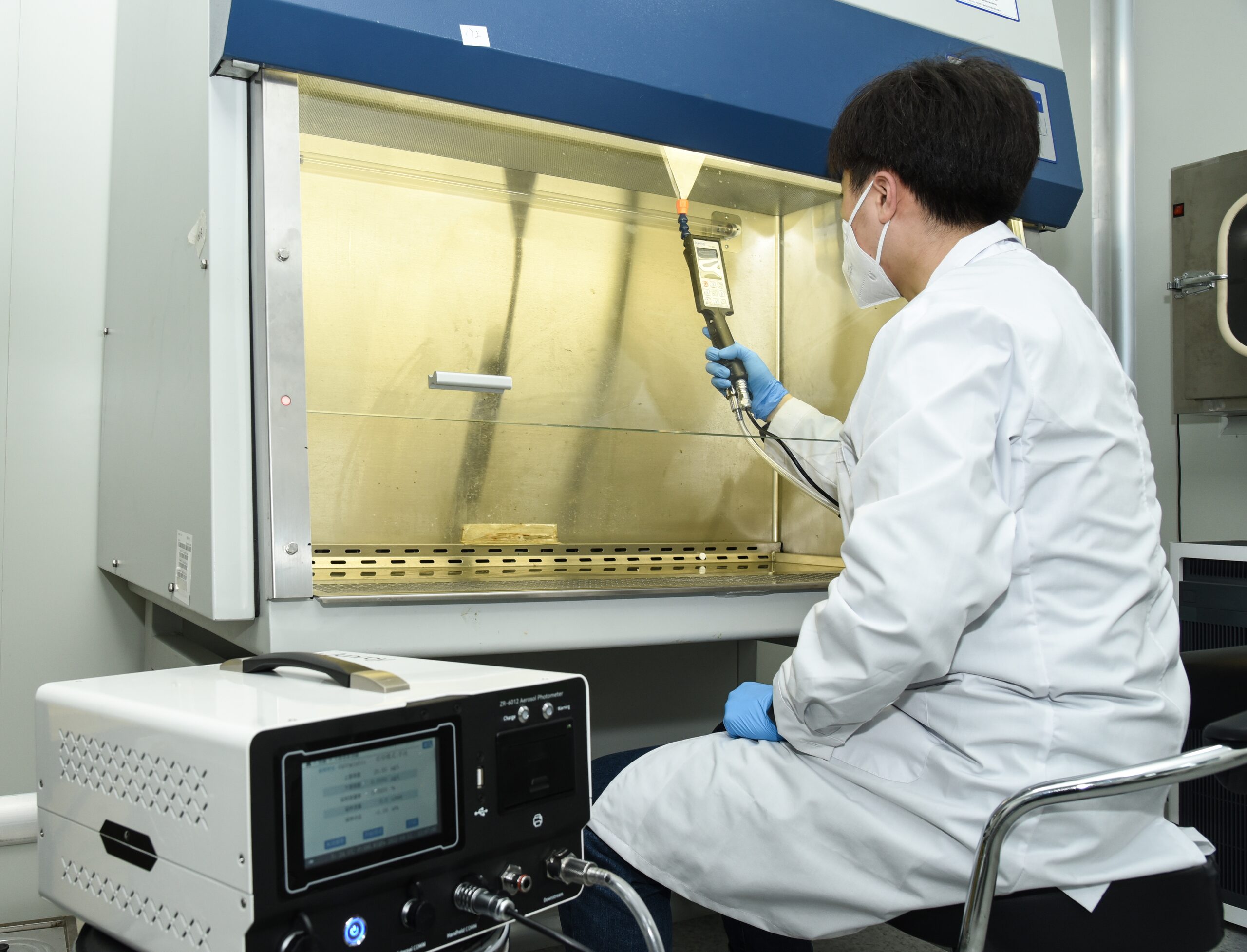
It is also why an installed filter needs to be tested in place. The factory classification says what the medium can do, not whether the installation seals.
Where the filter sits in the cleanroom
Air in a cleanroom passes through several filter stages. Prefilters capture coarser particles and protect the more expensive stages downstream. The final filter — HEPA or ULPA — sits last, closest to the room.
Prefilters are not HEPA filters and should not be confused with them. They serve a different purpose: extending the life of the final filter by removing the coarse fraction.
Our cleanroom panels cover HEPA and ULPA terminal filters for ceilings and filter terminals.
The filter and the cleanroom's classification
A common question is which filter class a given ISO-classified cleanroom requires. Filter class alone does not determine the room's classification. Air change rate, room layout, the processes running in the room and the movement of personnel all affect particle concentration at least as much.
The filter sets an upper bound on how clean the supply air can be. What the room actually achieves is decided once everything works together, and that is what cleanroom validation measures.
How we can help
We supply HEPA and ULPA filters for cleanrooms and controlled environments, and we measure what an installation actually delivers. If you need help selecting a filter class for your cleanroom design, or want an existing ceiling verified, get in touch and we will go through the requirements with you.
Frequently asked questions
High Efficiency Particulate Air. In EN 1822 the designation corresponds to classes H13 and H14, so it is not a collective term for all fine filters.
No. Classes E10–E12 belong to the EPA family and sit below the HEPA threshold, but are sometimes marketed as HEPA. Check the class designation under EN 1822 rather than the product name.
ULPA (U15–U17) sits above HEPA in EN 1822 and lets through less than H14 does. ULPA is used where requirements exceed what the HEPA classes can deliver.
More articles
What is air sampling and when is it needed?
An introduction to air sampling – what it involves, which situations require it, and what to expect from the process.
How to interpret an air sampling report
A guide to understanding your air sampling report – what the results mean, how they compare against reference values, and what actions may be required.
EU GMP Annex 1: requirements for air monitoring in pharmaceutical production
EU GMP Annex 1 sets strict requirements for air monitoring in aseptic production. Read about what is required for particle counting, microbial sampling and documentation.